
Teeth straightening
Clear aligners in Auckland
Straightening your teeth no longer means a mouthful of metal. Clear aligners in Auckland do the same work through a series of near-invisible, removable trays: a discreet, comfortable route to teeth straightening that suits plenty of adults and teens alike. You wear each set for a couple of weeks, then step into the next, easing your teeth gently into place. And because they come out to eat and clean, they slip into your life rather than rearranging it.
- 5.0 on Google from 91 reviews
- Southern Cross Easy-Claim
- Afterpay
- Free WINZ quotes
- ACC accepted
Is this you?
Clear aligners in NZ: who they suit
Clear aligners are often a good fit for mild to moderate crowding, spacing and bite issues. They're especially popular with adults who'd rather not wear metal braces to work, and with responsible teens. The one honest caveat is that they only work if they're worn as directed, generally most of the day and night, so they suit someone happy to commit to that.
Very complex bites can be better handled with fixed braces or a referral to an orthodontist, and if that's your situation we'll point you the right way rather than push aligners. The assessment (with a digital scan) tells us clearly whether they're the right tool for your teeth.
Why Supertooth
What aligners can help with
Gaps between teeth
Mild-to-moderate bite issues
A little movement back after old braces
Why it's worth it
Beyond the obvious discretion, aligners are usually comfortable: smooth plastic rather than brackets and wires. And because they come out, you eat whatever you like and brush and floss normally, which can keep your teeth healthier through treatment than fixed braces sometimes allow. A digital scan lets us show you a preview of where your teeth are heading before you commit, and there are no tightening appointments, just a straightforward change of trays on schedule with the occasional check-in. Once you're straight, a retainer helps keep everything in place.
Thinking about straighter teeth? Book an aligner assessment and we'll show you a preview of your new smile before you commit.
Aligners or braces? The plain differences
Aligners and braces move teeth the same way, with gentle, steady pressure that lets the bone around each tooth reshape, which is why both take months. Braces use brackets and a wire fixed to your teeth. Aligners use a series of clear trays, each shaped a little differently from the last.
Day to day, the big difference is that aligners come out. Braces stay on, so there's a list of hard, sticky and chewy foods to avoid, and they take more effort to clean around. But braces keep working even on the days you'd rather forget about them.
Braces often suit better when a tooth needs to move or turn a long way, or when your upper and lower jaws don't meet as they should. They can also be the better choice if you think you'd often leave a removable tray out. Our guide to clear aligners or braces has more detail.
What happens at your first consultation
The first visit is about finding out whether aligners suit you. We look at your teeth, gums and bite, take a digital scan, and ask what you'd like to change. If there's decay or gum disease, we treat that first, because moving teeth through inflamed bone can make the damage worse.
We then explain your options in plain language, with a rough idea of timing. A consultation is $60. You get a written quote, and no treatment starts on the day you first hear about it.
Wearing aligners day to day
Aligners only move teeth while they're in, so they're usually worn around 20 to 22 hours a day. They come out to eat, to drink anything other than water, and to clean your teeth. You usually move to the next set every week or two.
Falling behind matters. If a tooth hasn't moved as planned, the next trays may not fit properly, and treatment can stall.
Rinse the trays when they come out and clean them with a soft toothbrush and cool water. Hot water can warp the plastic and spoil the fit.
How long it takes
Treatment time depends on how much movement your teeth need: often several months for simpler cases, up to a year or more for bigger changes. We'll give you a realistic estimate at your assessment once we've seen your scan. Consistency is the biggest factor: the more faithfully you wear them, the more smoothly you'll stay on track.
Check-ins, and retainers afterwards
You'll come in for check-ins until you reach the planned result, so we can see your teeth are moving as expected and your trays still fit.
Teeth tend to drift back, most of all in the first year, so a retainer becomes a long-term habit. For most people that's a clear retainer you wear while you sleep, and sometimes a fine wire fixed behind the front teeth as well.
Keeping up with aligner check-ins
With clear aligners you change trays on schedule and come in for the occasional check-in, so a simple trip helps you stay on track. From Onehunga the drive is 12 to 13 minutes, and from Flat Bush or Epsom about 20 minutes. Māngere is about 7 minutes away. Check-ins from Papatoetoe mean about 16 minutes in the car, or 16 to 18 minutes from Ōtāhuhu.
It all starts with an assessment and a digital scan, which shows us if aligners are the right tool for your teeth.
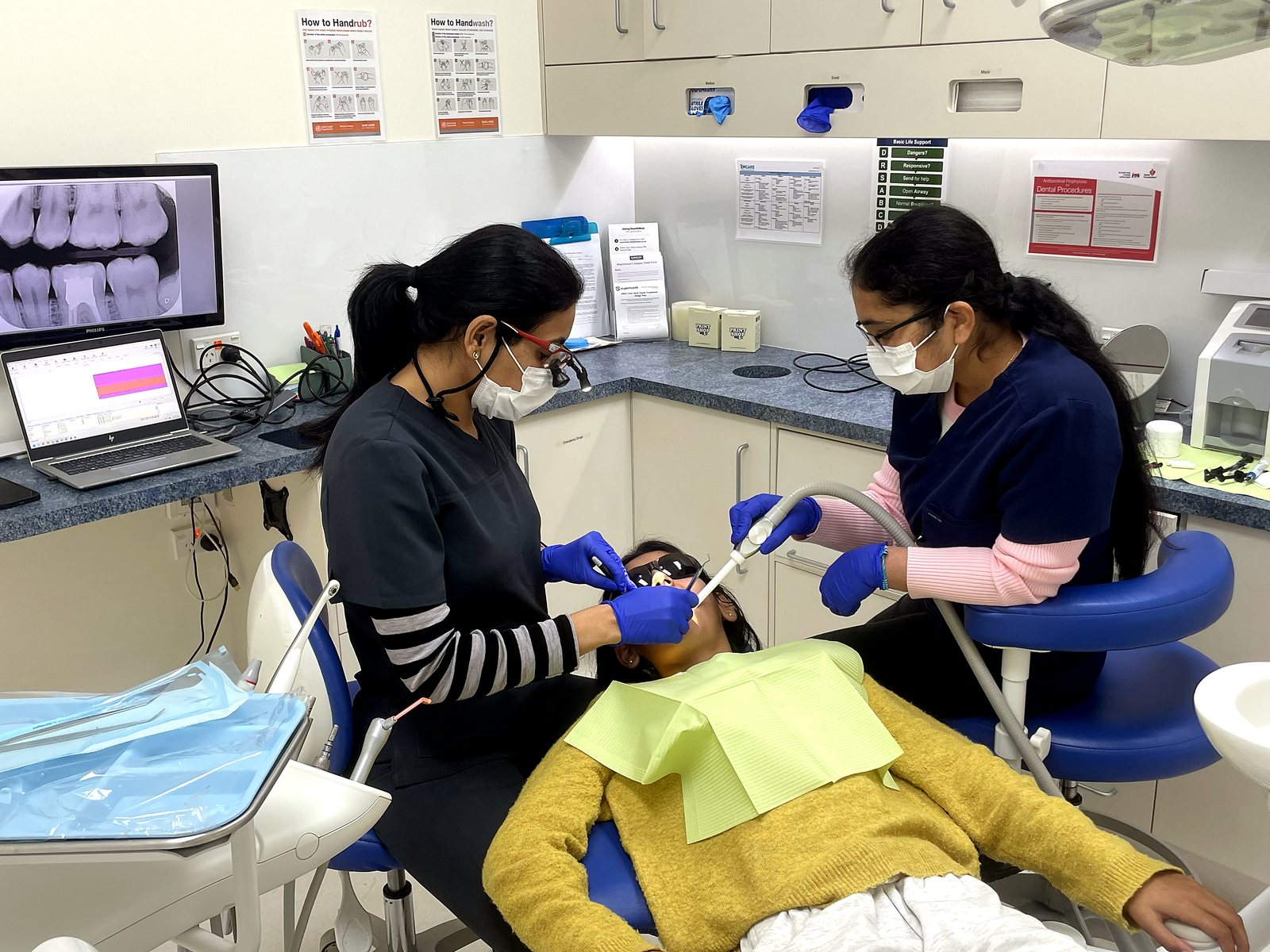
Your visit
Your clear aligner treatment, step by step
- 01
Assess & scan
We check your teeth and bite and take a digital scan to plan the movement.
- 02
Wear your aligners
Change to the next set on schedule, with occasional check-ins.
- 03
Retain
Once you're straight, a retainer keeps it that way.
Common questions
Clear aligner questions
They're clear and designed to be discreet. Most people won't spot them.
Usually just mild pressure for a day or two after each new set, while your teeth get used to it. It tends to ease quickly.
We'll recommend the system that suits your case; the assessment comes first.
Yes. Teeth like to drift back, so a retainer helps hold your new smile in place.
Usually around 20 to 22 hours a day. They come out for meals, for drinks other than water, and for brushing and flossing, then go straight back in.
Neither is better for everyone. Aligners often suit mild to moderate cases, while large movements and some bite problems are usually better handled with fixed braces. Your consultation tells us which fits your teeth.
It depends on how much your teeth need to move, so each case is quoted on its own. A consultation is $60, and you get a written quote before anything starts. We accept Afterpay and Q Card.
We wouldn't recommend it. The Dental Council of New Zealand and the New Zealand Association of Orthodontists have both cautioned people about mail-order aligners, as decay or gum disease can be missed without an in-person exam and X-rays.
Treatment time and results vary from person to person and depend on consistent wear. We'll assess and quote in writing first.
Costs, funding and what to expect
Plain-English articles from the Supertooth Dental Auckland blog, funding and costs first.
- Paying for dental treatment with Q Card and Q Mastercard in Auckland
Costs and Funding · 14 November 2026 · 5 min read
- Clear Aligners in Auckland: A Clearer Path to a Straighter Smile
Treatments · 8 September 2026 · 3 min read
- A more comfortable way to scan your teeth is coming to Supertooth
Treatments · 29 August 2026 · 3 min read

Your dentist
Dr Simran Chauhan
Principal Dentist · BDS · Registered Dentist (DCNZ)
Dr Simran leads the clinical team at Supertooth Dental Auckland. She holds a Bachelor of Dental Surgery and an Australian Dental Council qualification, and has spent over six years caring for families across Auckland.
Patients know her for an unhurried, gentle manner: she explains every step, goes at your pace, and takes extra time with anyone who finds the dentist hard.
Meet the team
Ready for a super smile?
Whether it's been six months or six years, you're welcome here. New patients, whānau and emergencies, always.