If a root canal, a crown, or a bridge came up at your last visit, you are not the only one trying to work out how they fit together. More often than not they are steps in a single plan to save, rebuild, or replace a tooth, and understanding the link makes the decision a lot easier.
Why a root canal and a crown often go together
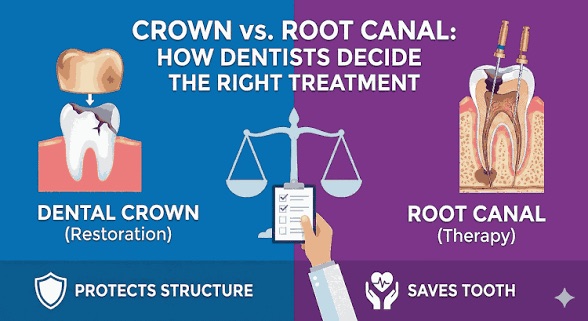
A root canal treatment removes infected or inflamed tissue from inside a tooth and seals it. This can settle pain and let you keep a tooth that might otherwise be lost. What surprises many patients is that the root canal is often only half the job.
Once the inside of a tooth has been treated, the tooth is usually more brittle than before, especially a back tooth that does a lot of chewing. A dental crown fits over the remaining tooth like a protective cap, restoring its strength and shape and lowering the risk of a fracture. A front tooth with a small access point can sometimes be restored with a filling, while molars and premolars are more commonly fitted with a crown. That is why a root canal and a crown are often planned as a sequence rather than two separate events.
Where bridges fit in
A dental bridge replaces a missing tooth by anchoring a replacement to the healthy teeth on either side. Those neighbouring teeth are prepared and fitted with crowns, which hold the bridge in place. In other words, crowns are the foundation a bridge is built on, and now and then an anchor tooth needs its own root canal first if the nerve is affected during preparation.
This is where the three treatments meet. When a tooth is badly damaged, the question is often whether to save it with a root canal and a crown, or to remove it and close the gap with a bridge or another option. There is no single right answer. It depends on how much healthy tooth is left, the condition of the teeth around it, and what matters most to you.
A typical sequence of care
Every mouth is different, so the exact plan is set after an examination. A common path looks like this.
- 1/An assessment with digital X-rays to see the extent of the decay, damage, or infection
- 2/Root canal treatment if the tooth can be saved and the nerve is involved
- 3/A core build up to create a stable base inside the tooth
- 4/A crown to protect and restore the tooth, or crowns on the anchor teeth to support a bridge
- 5/A review to check the bite and the finish
Saving a tooth or replacing it
Patients often ask which is better, saving a tooth or replacing it. Keeping your own tooth is usually the first thing to consider, because a natural tooth root helps maintain the bone and the way your teeth meet. If a tooth is too broken, or the supporting bone is not healthy, removing it and replacing it can be the more sensible path.
The aim of your appointment is to lay out the choices in plain language, with a written quote, so you can weigh them up without pressure. You are always free to take the information away and think about it.
How Supertooth Dental Auckland approaches it
At Supertooth Dental Auckland this kind of restorative care is planned and carried out in one place, so you are not moved between providers partway through. Dr Simran Chauhan, our Principal Dentist, talks through the options, save or replace, and what each one involves, before any treatment begins. We are used to looking after nervous patients and we keep to a pace that suits you.
For crowns and bridges we take digital impressions with a Dentsply Sirona Primescan 3D intraoral scanner instead of traditional putty moulds, which many patients find more comfortable and which supports an accurate fit. You will have a written quote before any treatment starts, we can lodge ACC claims for dental injuries, and we can provide written quotes for WINZ assistance where you may be eligible. Afterpay and Southern Cross Easy-Claim are both accepted.
We are at the Auckland Airport Shopping Centre with free parking at the door, and we are open on Sundays. If you are new to the practice, the first exam with digital X-rays is $79, which is a simple way to find out what, if anything, your teeth need. If you have a cracked, loose, or painful tooth and need to be seen sooner, our emergency dental care is a good place to start. To book, visit supertooth.co.nz/contact or send a text to 022 852 4000.
Quick questions
- Does a root canal always need a crown?
- Not always. A front tooth with a small opening can sometimes be restored with a filling, while molars and premolars are more likely to need a crown because they take heavier chewing forces. Your dentist will advise based on how much healthy tooth remains.
- How long does the whole process take?
- It varies with the tooth and your healing, but a root canal and crown are usually completed over a small number of visits. You will be given a timeline at your assessment.
- Will the treatment hurt?
- Treatment is carried out with local anaesthetic to keep you comfortable during the appointment. Some tenderness for a few days afterwards is normal, and your dentist will tell you how to manage it.
- Can I get help with the cost?
- Yes. You will receive a written quote first, and Afterpay and Southern Cross Easy-Claim are accepted. We can lodge ACC claims for dental injuries and provide written quotes for WINZ assistance if you may be eligible.
Sources: New Zealand Dental Association · Health New Zealand, Te Whatu Ora · ACC, Accident Compensation Corporation. This article is general information, not a substitute for an examination and personal advice from a dentist. If you're in pain or unsure, book a visit or call 022 852 4000.
Keep reading
- Saving Teeth, Restoring Smiles: How Dr Simran Approaches Root Canals, Crowns and Bridges in Auckland
Treatments · 12 September 2026 · 3 min read
- A more comfortable way to scan your teeth is coming to Supertooth
Treatments · 29 August 2026 · 3 min read
- Crowns and Bridges: Restoring Broken and Missing Teeth
Treatments · 17 August 2026 · 4 min read