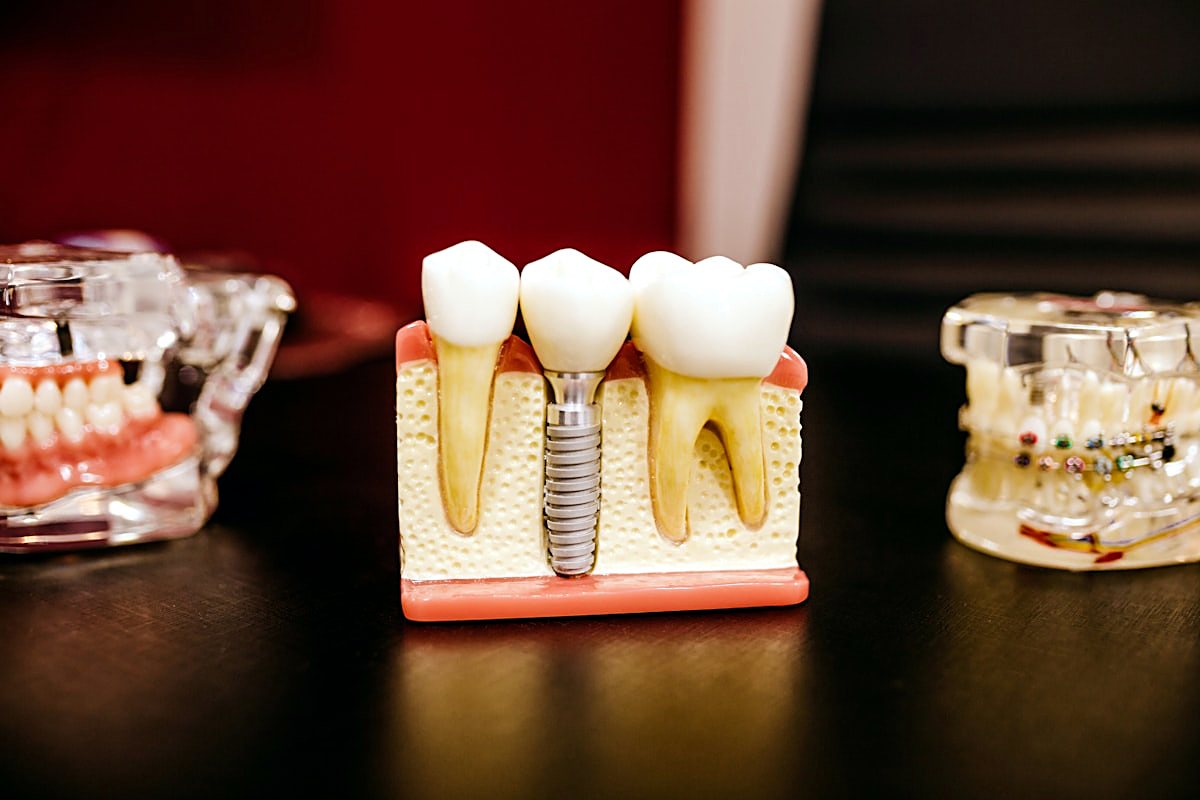
An implant is not one appointment with a new tooth at the end of it. It is a staged treatment that runs across several months, and the waiting in the middle is the part that makes it work. Here is the whole journey, start to finish, without the gloss.
An implant is three separate parts
The post is a small titanium screw placed into the jawbone, and it does the job the natural root used to do. The abutment is a short connector that sits on top of the post and pokes through the gum. The crown is the visible tooth. Three parts, made and fitted at different stages, which is the first clue as to why implant treatment is spread over months rather than weeks.
The post is what most people mean when they say implant. It is roughly the size of a natural tooth root, and once bone has grown tight against its surface it becomes a fixed foundation. That foundation can then carry a single crown, or a bridge across a gap, or clips that hold a denture steady.
That last point catches people out. The number of posts is not the same as the number of teeth being replaced. A well-planned pair of implants can support a bridge of three teeth, and a set of four to six can anchor a full arch. Part of the planning is working out the fewest posts that will do the job properly.
The assessment, and why bone matters so much
The first visit is mostly talking and looking. We go through the tooth or teeth in question, your medical history, any medications, and whether you smoke, because all of those change what is sensible. We examine your gums carefully, since gum health around the neighbouring teeth predicts a lot about how an implant will fare. A consult is $60, and an OPG, the wide X-ray that shows both jaws in one image, is $100.
The reason imaging matters is bone. An implant needs enough bone, in the right shape and the right place, to hold it steady while it heals. Bone is a use-it-or-lose-it tissue, and once a tooth comes out the bone that supported it starts shrinking, fastest in the first year. So a gap that has been there a long time often has less bone to work with than a fresh one.
If there is not enough, that is not automatically the end of it. A bone graft can rebuild the site, and where an upper back tooth is involved a sinus lift may be needed to make room. Both work, and both add months and cost to the plan, so you should know about them before you commit rather than halfway through. Where more detail than an OPG is required, a three-dimensional scan may be recommended, and we will tell you plainly if that means going elsewhere for the scan.
Placing the post
The placement appointment is done in the chair under local anaesthetic, and for a single implant it usually takes around an hour. The area is numbed thoroughly, a small opening is made in the gum, a channel is prepared in the bone at a planned angle and depth, and the post is placed into it. Most people say afterwards that they felt pressure and vibration rather than anything sharp.
For a few days after, expect some swelling, a bit of bruising in some cases, and tenderness that ordinary pain relief usually handles. Soft kai for a while, no poking at the site, and no smoking, which interferes with healing more than almost anything else you could do. You go home with written aftercare rather than a vague instruction to take it easy.
What happens to the gum over the top varies. Sometimes the site is closed over completely and left to heal quietly. Sometimes a healing cap sits through the gum from day one. Occasionally a temporary tooth goes on straight away, though that depends on how solid the post feels at placement and where it sits in the mouth. None of this is a matter of preference, it follows what the bone allows.
Osseointegration: the months in the middle
The healing phase has a name, osseointegration, and it simply means bone growing directly onto the surface of the titanium. It is not glue and it is not a clamp. Living bone remodels itself against the post until the two are locked together. Commonly that takes three to six months, and longer where grafting was part of the plan.
This is the honest answer to why implants cannot be rushed. Loading a post with chewing force before the bone has done its work is one of the main ways implants fail early, and no amount of good intention shortens the biology. When someone describes a same-day tooth, what they usually mean is a temporary crown kept out of the bite while the same healing quietly happens underneath.
You are not abandoned during this stretch. There are short review appointments to check the site is settling, and where the gap is visible we talk through temporary options beforehand so you are not caught out socially. It is worth planning the timing around anything big in your calendar, since the middle months are the least flexible part.
Fitting the crown
Once the post has integrated, we test it and take an impression or a digital scan of the area. That goes to the laboratory with notes on the shade, shape and character of the teeth either side, because a crown that is technically perfect but the wrong colour is not a success. There is usually a couple of weeks between the scan and the fitting.
At the fitting, the abutment goes on, the crown is tried in, and a good chunk of the appointment is spent on the bite. This part matters more than it sounds. A natural tooth sits in a ligament that cushions it and tells your brain how hard you are biting. An implant is fused straight to bone with no such cushion, so the contacts have to be adjusted carefully to keep the force sensible.
After that you have a tooth that you use normally. Most people report it feels unremarkable within a few weeks, which is the point. Results do vary between people, and things like gum shape, smile line and the condition of neighbouring teeth all influence how invisible the final result looks.
Looking after an implant
An implant cannot decay, and that fact has misled a lot of people into thinking it needs less attention than a real tooth. The gum and bone around it can absolutely become diseased. It is called peri-implantitis, it behaves much like gum disease around natural teeth, and left alone it dissolves the bone holding the post until the implant loosens and is lost.
So the maintenance is the same as for the rest of your mouth, done properly. Brush twice a day along the gumline, clean between the teeth daily with floss or the small interdental brushes, and keep to a regular hygiene rhythm so hardened deposits get removed before they cause trouble. A scale and clean starts from $150.
Three things shorten an implant's life more than anything else: smoking, poorly controlled diabetes, and untreated gum disease elsewhere in the mouth. Heavy grinding is a fourth, and if you grind we will usually recommend a nightguard to protect the crown and the bone around it. Implants have a strong long-term record in people who are well selected and who maintain them, but nobody can promise a particular outcome for a particular mouth.
How it honestly compares with a bridge or a denture
A bridge fills the gap by joining to the teeth on either side. It is quicker, usually a few weeks, and involves no surgery and no waiting for bone. The trade is that the neighbouring teeth have to be shaped down to carry it, and that cannot be undone. If those teeth already have large fillings or crowns, that is a reasonable trade. If they are pristine, it is a real cost.
A partial denture is the least invasive option and the quickest to make. It is removable, it can replace several teeth at once, and it is the lowest outlay of the three. Some people get on with a denture perfectly well. Others never quite make peace with something that comes in and out, and a denture does nothing to slow the bone shrinking underneath it.
An implant asks the most of you in time and in money. In return it stands on its own without touching the neighbouring teeth, and because it loads the bone it helps hold that bone where it is. It is not the right answer for everyone, and there are mouths where a bridge or a denture is genuinely the better fit. Whatever the plan ends up being, you get it in writing with a quote before we start.
- 1/Bridge: no surgery, done in weeks, but permanently alters the two teeth beside the gap.
- 2/Partial denture: least invasive and lowest cost, removable, does not preserve the bone underneath.
- 3/Implant: longest timeline and highest outlay, leaves the neighbouring teeth alone, keeps the bone loaded.
Quick questions
- How long does the whole implant process take?
- For a straightforward single implant, commonly six to nine months from assessment to the crown being fitted. If a bone graft is needed first, add several months to that. It is staged over time by design, because the bone has to grow onto the post before it can carry chewing force.
- Does placing the implant hurt?
- The area is numbed thoroughly with local anaesthetic, and most people describe pressure rather than sharpness during the appointment. Afterwards there is usually a few days of tenderness and swelling that ordinary pain relief manages. Tell us beforehand if you are nervous and we will slow the whole thing down.
- Am I too old for an implant?
- Age on its own is rarely the deciding factor. What matters is bone volume, gum health, general health and any medications that affect healing or bone, which is exactly what the assessment is for. Some medications used for osteoporosis do need careful discussion, so bring your full list.
- What will it cost?
- Implant treatment is quoted individually, because the number of posts, whether grafting is needed and the type of crown all change the figure. A consult is $60 and an OPG X-ray is $100, and you get a written quote covering the whole plan before we start any treatment. Airport staff get 15% off.
Sources: New Zealand Dental Association, patient guidance on replacing missing teeth · Dental Council of New Zealand, standards for practice and informed consent · Te Whatu Ora / Health New Zealand, oral health information for adults. This article is general information, not a substitute for an examination and personal advice from a dentist. If you're in pain or unsure, book a visit or call 022 852 4000.